
The Curious Case of Creole Continium

I’ve spent a good part of my life tracing a quiet, fascinating thread that runs across continents—the Indian diaspora. Not the versions of India found in textbooks or migration charts, but the versions I keep finding in places that have no business feeling like India at all. I've eaten chapati and curry with Indo-Fijians in Suva, argued cricket with Trinidadians of Indian descent in Port of Spain, and watched Diwali light up the East African sky from Nairobi to Kampala. In fact, one of the great joys of globe-trotting — a delight I didn't anticipate when I first caught the travel bug — is stumbling upon little pockets of India, scattered across the planet like chai-scented breadcrumbs, wherever the British Empire once planted its flag and ran short of labour.
From the vibrant lanes of Kuala Lumpur to the rum-soaked rhythms of the West Indies, from the volcanic islands in the Indian Ocean to the remote beauty of Fiji - I’ve seen how migration carries more than just people. It carries recipes, rituals, languages, and a quiet but stubborn sense of identity. Overall, what I’ve come to realize is this: The Indian diaspora is not a monolith. It’s a living, breathing experiment in cultural evolution. Everywhere it travels, it doesn’t just survive. It adapts. It blends. It mutates. And in doing so, it leaves behind something entirely new—yet faintly, unmistakably familiar.
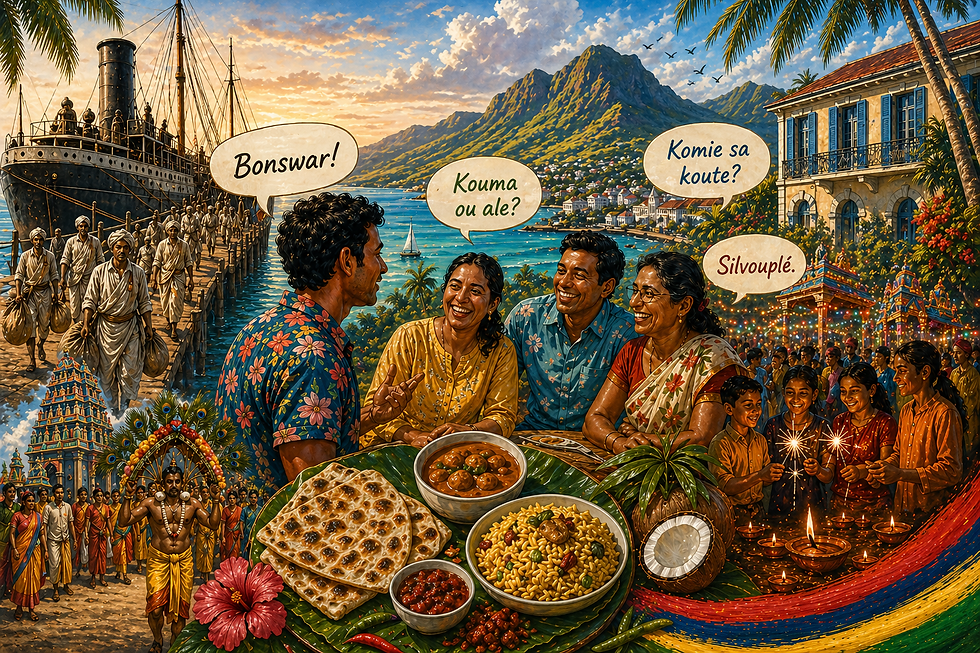
So when I landed in Mauritius, I expected the familiar warmth of that recognition. The faces, the temples, the smell of curry leaves and fenugreek drifting from somewhere nearby. I got all of that. What I did not expect was to feel like I'd landed in a French colony where everyone had somehow misplaced their copy of the family history.
Read on to get a drift of what I am talking about. Or wait until I publish my next book, which captures this fascinating topic in its own chapter!
Let me set the scene. I'm at a small restaurant on the southern coast of Mauritius. The faces around me are unmistakably South Asian — the bone structure, the colouring, the gestures. People of Indian origin make up almost 70% of Mauritius's population. They run the country, politically and economically. This is, by every demographic measure, an Indian island.
And yet the table beside me is deep in animated conversation — in Creole. Not Hindi. Not Bhojpuri. Not Tamil. Kreol Morisien, the French-based Creole that is the lingua franca of the island. I lean over, friendly traveller that I am, and ask where their families are originally from. They look at each other. Then back at me. One says, with complete warmth and zero defensiveness: "We are Mauritian." Their ancestral heritage? A polite shrug. "From India, a long time ago."
I have a theory about why this happened — and it requires a brief look at the colonial fabric that shaped Mauritius's cultural fate. When Britain abolished slavery in 1834, the empire turned to India for replacement labour. Nearly 450,000 indentured workers arrived in Mauritius between 1834 and 1917, making it the largest receiving colony in the Indian Ocean. They came overwhelmingly from Bhojpur (Bihar and eastern UP) and from Tamil Nadu and Andhra Pradesh. The numbers were staggering — by volume, more Indians arrived in tiny Mauritius than virtually anywhere else per square kilometre.
But here's the twist: the French had already been running Mauritius for 150 years before the British took it over in 1810. And the French cultural layer — the language, the social habits, the Catholic-inflected rhythms of daily life — was already baked in. When the British arrived, they brought English as the language of administration, but French and Creole had long claimed the streets, the kitchens, and the everyday conversations. The Indian labourers arrived into a society where the prestige language was French, the social glue was Creole, and English was the language of official forms nobody enjoyed filling out.
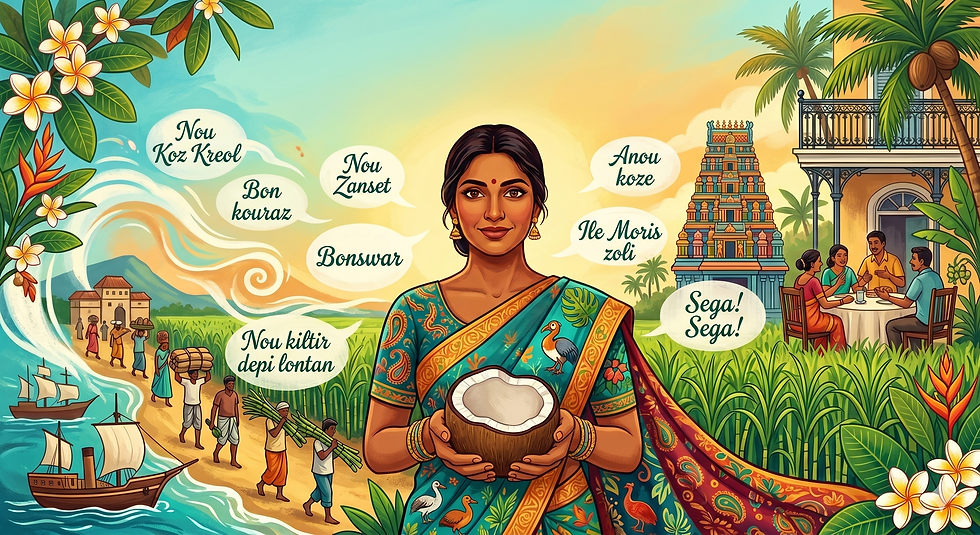
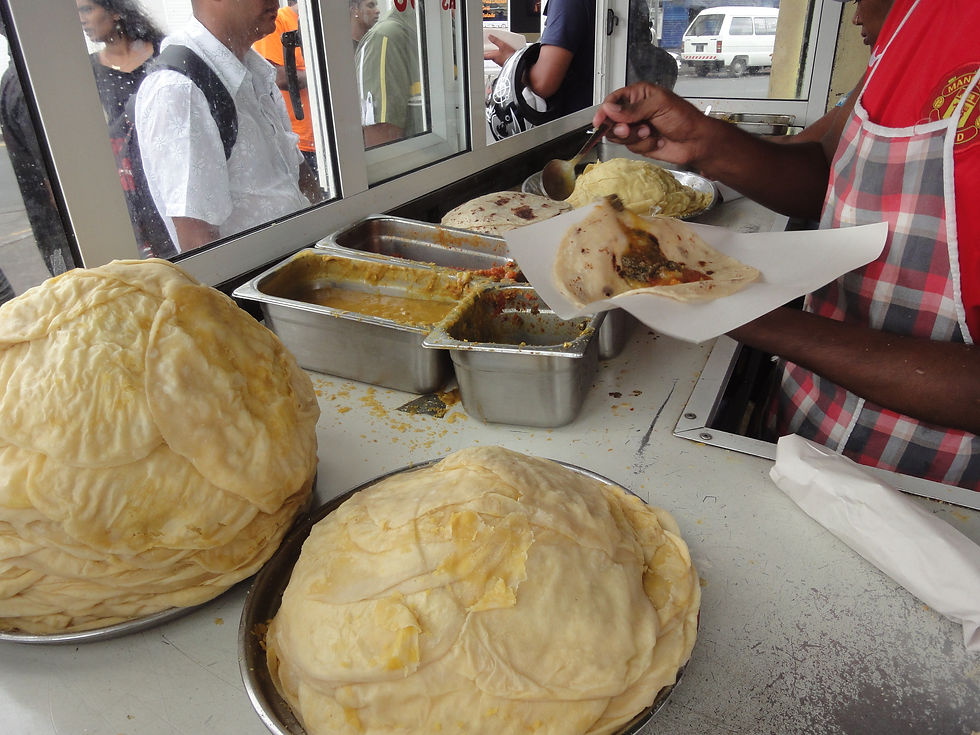
The result, six generations later, is a community that is ethnically Indian, culinarily Indian (the dholl puri is glorious, the biryani is not embarrassing, the temples are everywhere and full on festival days), spiritually Indian (Diwali and Cavadee — the Tamil fire-walking ceremony — are celebrated widely) — but linguistically and culturally completely Creolised. A typical Mauritian of Indian descent might speak Creole at home, French to the media, stumble through English at school, and dust off a few lines of Bhojpuri or Tamil only for temple visits. The ancestral languages have largely become ceremonial objects, taken out for special occasions and placed carefully back in the cupboard.
In every other former British colony where Indian labour was deployed, the British set the linguistic and cultural terms. English became the prestige language. India retained enough cultural bandwidth to maintain its identity within an English-speaking framework. In Mauritius, the French got there first — and by the time the Indians arrived, the operating system was already installed.
Is this an erasure? I don't think so. Mauritius hasn't lost its Indian soul so much as it has dissolved it into something new. The spices are there, in every kitchen. The temples are there, on every road. The festivals light up the calendar. What's changed is the packaging — the language of daily life, the cultural mode in which all of this is expressed. Mauritius's Indian diaspora didn't forget where it came from. It just stopped needing that fact to be the loudest thing in the room.
Charming? Absolutely. A little bewildering to a globe-trotting Indian traveller who expected a Tamil brother and got a Francophone cousin instead? Also yes.


Comments