
Karnataka: One State, Many Worlds

India is often described as a world unto itself. Spend enough time travelling across the country, and you will surely be blown away by its incredible diversity. Every few hundred kilometers, languages change, accents shift, cuisines transform, architectural styles shift, and customs & cultural identities evolve with remarkable speed. Yet nowhere have I encountered this phenomenon more intensely than in the state of Karnataka.
On paper, Karnataka is a single state in southern India. On the ground, it often feels like several distinct worlds sharing the same map. Drive across Karnataka, and you begin to feel as though you are crossing invisible national frontiers. The people look different, speak different languages, worship differently, cook differently, and even tell their stories through entirely different architectural traditions. For a traveler, it is one of the most rewarding journeys in India. For anyone interested in culture, it is a reminder that political boundaries rarely tell the whole story.
One Land, Many Languages
Every tourism board promises the extraordinary. Most deliver the merely pleasant. But Karnataka's tagline is different. Its slogan of "One State Many Worlds” is not marketing hyperbole. It's a geographical and anthropological fact, and no single moment illustrated it more vividly for me than a roadside exchange near Kapu Beach that produced exactly zero words of mutual understanding between two men from the same state.
During a road trip from South Goa to Mangalore, tracing the spectacular Karavali Coast along the Arabian Sea, we hired a car and driver to take us through one of India's most scenic coastal journeys. Our driver happened to be from Karwar, a town in the state's far north near the Goa border, a region shaped as much by Konkan influences as by Karnataka itself.
During this multi-day trip, we happened to stop near Kapu Beach in the Udupi region to ask a local for directions. What followed was a communication circus that perfectly captured the extraordinary complexity of Karnataka.
The conversation began in Tulu. Our driver understood nothing. Sensing the problem, the local switched to Kannada, Karnataka's official language. Problem solved, I thought.
Not quite.
Our driver, from Karwar near the Goa border, spoke Konkani and Hindi with ease but understood little to no Kannada.
The local, meanwhile, knew little Konkani. What followed was several minutes of determined communication involving multiple languages, enthusiastic hand gestures, repeated pointing toward the horizon, and a level of mutual confidence that far exceeded their actual understanding.
Somehow, directions were eventually exchanged.
Watching two men from the same state struggle to find a common language was both amusing and revealing. It was also my first hint that Karnataka contains far more worlds within its borders than most people realize.
To outsiders, Karnataka might appear to be monolingual on the surface. On the ground, it often feels anything but. As my travel experience taught me, its coastal belt is home to a remarkable mix of languages. In and around Udupi and Mangalore, Tulu remains the dominant language for many communities. Konkani is widely spoken by the Goud Saraswat Brahmin community. Beary, a language with Arabic influences, thrives among parts of the Muslim population. Kannada exists alongside them, but often as a second or third language in daily life.
Move inland into Kodagu and many families still speak Kodava Takk, a language distinct enough that a Kannada speaker from Bengaluru would struggle to follow a conversation. Head toward Belagavi in the northwest and Marathi becomes deeply woven into everyday life. In fact, many residents of Belagavi often feel culturally closer to neighboring Maharashtra than to southern Karnataka. The food, language, festivals, and social influences reflect centuries of interaction across what is today a state boundary.
Few places in the world contain so many living linguistic ecosystems within a single administrative region.Belgium has lingual divisions. Switzerland has multiple national languages. Spain has strong regional identities. Karnataka somehow combines aspects of all three while remaining largely unknown internationally for this characteristic.

One Roof, Many Tribes
If Karnataka's languages reveal its diversity, its people and traditions bring it vividly to life.
The Kodavas of Coorg possess a distinct identity unlike almost any other community in India. Traditionally martial in nature, they celebrate festivals such as Kailpodh and Puthari, maintain unique ancestral homes known as Ainmanes, and have customs that differ markedly from neighboring regions. Their cuisine revolves around ingredients and preparations that feel entirely their own, from Pandi Curry to bamboo shoot dishes.
Along the coast, Tulu-speaking communities have preserved traditions that predate many modern institutions. Yakshagana performances blend dance, music, theater, mythology, and elaborate costumes into all-night spectacles. Bhoota Kola ceremonies, where spirit worship remains an active part of community life, can feel almost otherworldly to first-time visitors.
The coastal Saraswat Brahmins offer another glimpse into Karnataka's complexity. Visitors expecting a conventional image of a vegetarian Brahmin community are often surprised to find seafood occupying a cherished place at the dining table, a legacy of their deep roots along the fish-rich Konkan coast
In northern Karnataka, the cultural atmosphere shifts once again. Folk traditions, music, literature, and festivals reveal stronger Deccan influences, shaped by centuries of interaction with neighboring Maharashtra, Telangana, and the region's former princely states.
Mysuru offers yet another expression of Karnataka's identity, shaped by the legacy of the Wodeyars, the grandeur of Dasara celebrations, classical arts, and a courtly culture that continues to influence the region today.
Then there is Bengaluru. India's technology capital is arguably one of the country's most cosmopolitan cities. Walk through neighborhoods such as Indiranagar, Koramangala, or Whitefield, and you hear languages from every corner of India and increasingly from around the world. Yet just a few hours away, village life continues according to rhythms that have changed little for generations.
What makes Karnataka fascinating is not merely the existence of these identities. It is the fact that they coexist within a relatively compact geography. A traveler can encounter several cultural worlds over the course of a single trip.
One Plate, Many Dishes
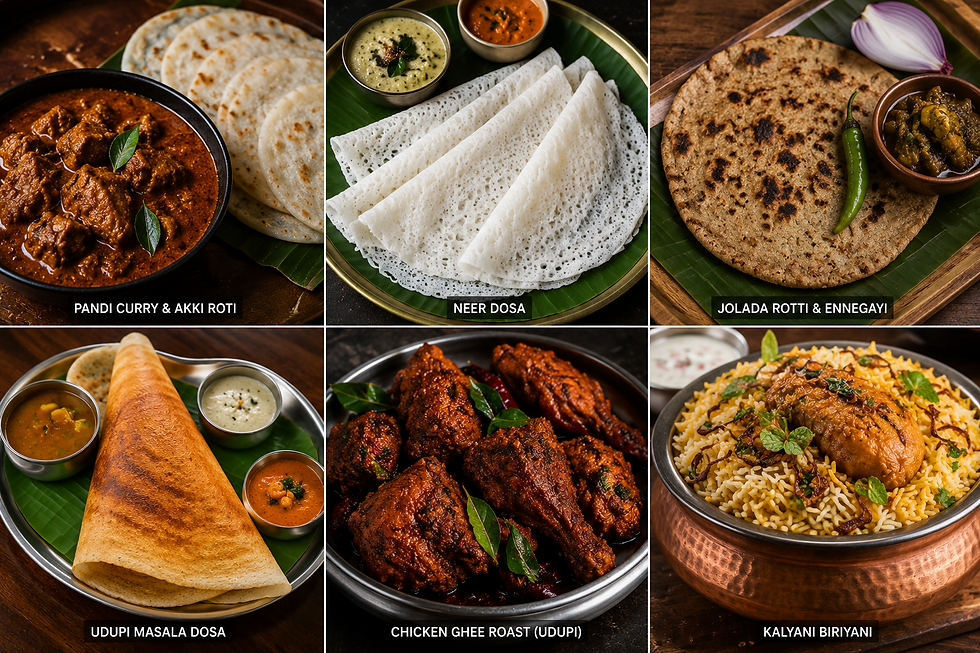
One of my favorite ways to measure the diversity of a land is not through language or architecture, but through the meals. In Karnataka, a single trip can take you from seafood curries simmering along the Arabian Sea to smoky Kodava pork dishes in the hills of Coorg, before ending with jolada rotti and fiery chutneys on the plains of the north. Each meal feels rooted in a different landscape. Each cuisine reflects a different history. Together, they form one of the most varied culinary journeys anywhere in India.
Ask an international traveler about Karnataka cuisine, and they will likely mention the famous Udupi restaurants found across India. While delicious, they represent only a tiny slice of the story. Few travelers realize that moving from Mangalore to Coorg to Hubballi can feel as dramatic gastronomically as traveling from Portugal to Germany. The ingredients, cooking methods, flavors, and dining traditions can be startlingly different.
Along the coast around Mangalore and Udupi, seafood reigns supreme. Kane fry, kori rotti, neer dosa, prawn ghee roast, crab gassi, and countless fish curries reflect centuries of life shaped by the Arabian Sea.
Move inland to Kodagu and the menu changes dramatically. Pork takes center stage in the celebrated Pandi Curry. It's served with akki rotti, a thick rice flatbread. Rice takes different forms. Bamboo shoot preparations, wild mushrooms, forest greens, and fragrant rice dishes reveal a cuisine deeply connected to the surrounding hills and forests.
In northern Karnataka, the landscape grows drier and so do the culinary traditions. Meals become heartier and often spicier. Jolada rotti, ennegayi, shenga chutney, and a variety of robust curries dominate dining tables. The cuisine shares certain characteristics with neighboring Maharashtra while maintaining a personality all its own.
Along the Konkan coast, the food of the Saraswat communities adds yet another dimension. Seafood curries, fish fry, and coconut-rich preparations challenge many outsiders' assumptions about what a traditional Brahmin cuisine looks like.
Bidar, in the far northeast corner, is a city that spent centuries under the Bahmani Sultanate. Its food reflects that history. Persian and Central Asian flavors arrived through the Deccan sultans' kitchens and never quite left. Dishes such as Kalyani Biryani and richly spiced meat preparations still carry echoes of those royal kitchens. A thali from Bidar and a thali from Udupi are not regional variations of the same meal. They are meals from different civilizations. Karnataka's tourism board surely got it right: you are not moving between districts. You are moving between worlds.
One Soil, Many Empires
Perhaps the most overlooked aspect of Karnataka's diversity is its architecture. Many Indian states possess a relatively recognizable architectural style. Karnataka feels like a living museum of competing influences.
The magnificent ruins of Hampi showcase the grandeur of the Vijayanagara Empire. Massive boulders frame temples, markets, royal enclosures, and monuments unlike anything else in India. The architecture reflects a powerful South Indian kingdom that once attracted merchants from Persia, Portugal, and beyond. Travel to Belur and Halebidu, and you encounter the extraordinary craftsmanship of the Hoysala dynasty. Pattadakal has temples built in both the northern Nagara style and the southern Dravidian style, sometimes within meters of each other. It reads like an architectural laboratory, a place where craftsmen from across the subcontinent were invited to compete and collaborate on the same sacred hillside.
Further north, the skyline of Vijayapura tells a different story altogether. Monuments such as Gol Gumbaz reflect the legacy of the Deccan Sultanates. The domes, arches, and Islamic architectural elements feel worlds apart from the temple complexes of southern Karnataka. The Ibrahim Rauza in Bijapur, a mausoleum completed around 1626, is so refined in its proportions that some historians believe it was a direct inspiration for the Taj Mahal. You stand before it and feel the full aesthetic ambition of the Deccan Sultanates, a culture that synthesized Persian, Turkish, Indian, and Abyssinian influences into something that belonged entirely to this plateau. Not to forget the stunning 15th-century fort and madrassa complex in Bidar, which looks like it belongs in Samarkand or Isfahan, with arched Persian corridors and tilework glazed in turquoise and cobalt.
On the coast, Portuguese influences appear in churches and colonial-era structures, particularly in communities shaped by centuries of maritime trade. Even traditional homes differ dramatically. A Kodava Ainmane bears little resemblance to a coastal Konkani residence or a traditional courtyard home in northern Karnataka.
All these monuments are not just variations on a theme. They are genuinely different architectural civilizations, each shaped by different empires, traders, kingdoms, religions, and communities, all of them happening to occupy what is now a single Indian state.

One Boundary, Many Identities
After visiting every country on earth, one of the things that stayed with me most was how arbitrary national borders really are, how often they cut through communities, sever cultural ties, and impose identities on people who never asked for them. Karnataka offers a version of that lesson at the state level, and it is an unusually honest one.
The Reorganisation of States in 1956 tried to create linguistically coherent units, grouping Kannada speakers under one roof. What it actually produced was a state defined by one dominant language while absorbing multiple other communities with their own tongues and cultures who came along for the administrative ride. Sections of Belagavi's population still identify strongly with Maharashtra and continue to support its long-running territorial claim. The Kodavas have periodically asked for a separate state. Tulu speakers make a reasonable case that their language, older than many of the officially recognized ones, deserves a spot on the national list it still hasn't earned.
This might not be unique to Karnataka. But Karnataka makes it unusually visible because the contrasts are so sharp and the distances so small. A journey from Belagavi's Marathi-flavored streets to Kodagu's coffee-scented silence or from Udupi's temple kitchens to Bidar's Deccani forts would cross not just geography but much more than that. People eat differently, pray differently, build differently, and apparently, as my driver discovered on a roadside near Kapu, cannot always communicate with the person standing five feet away who technically lives in the same state.
Many Worlds, One Home
Perhaps the greatest surprise about Karnataka is not that so many different worlds exist within its borders. It is that they coexist so naturally.
A Kodava farmer in the misty hills of Coorg, a Bhoota Kola performer on the coast, a Marathi-speaking shopkeeper in Belagavi, a Konkani-speaking Saraswat family gathered around a seafood feast, and a software engineer in Bengaluru may inhabit vastly different cultural worlds. Yet all call the same state home.
Few places on Earth compress so much diversity into such a compact space. Come here expecting India in miniature, and you'll miss the point entirely. Come expecting five or six distinct civilizations sharing an administrative border, and suddenly the coffee hills, the coastal theatres, the Deccan ruins, and the granite temples stop feeling like tourist attractions and start feeling like what they actually are: separate worlds, each with its own history, its own tongue, its own traditions, and its own understanding of what it means to belong.



Comments