
Passport & Popcorn - A Traveler's Cinema Diary

I never set out to collect countries. I set out to collect stories, and somewhere along the way, without a passport until I was twenty-five, I found myself having walked through all 193 of them. People assume that kind of travel is about monuments and checklists. It rarely is. The real education happens in the ordinary corners nobody photographs, and in the places locals go to unwind rather than to perform their culture for a visiting camera. And few corners are as revealing, or as consistently overlooked by every guidebook I have ever carried, as the local cinema hall.
Most travelers spend enormous effort trying to "live like a local." They eat at neighborhood restaurants instead of tourist traps, take public transport, wander through markets, or attend local festivals. Those are wonderful ways to understand a place. But I have stumbled upon another ritual that rarely appears in guidebooks. Sit down among the locals at the movies. Not the tourist show, not the folk performance staged for visitors, not the curated cultural evening with a fixed menu and a fixed narrative about what this place is supposed to mean to you.
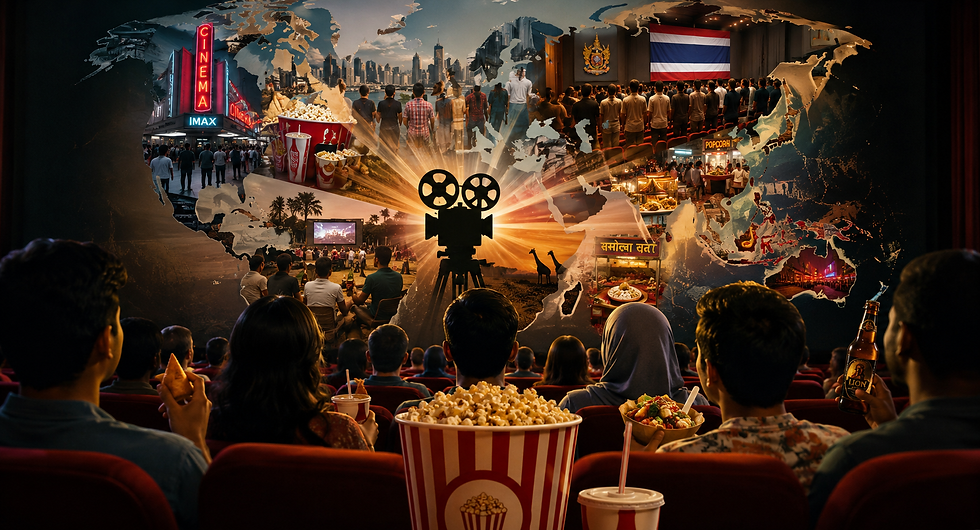
A regular Tuesday night screening, ticket bought at the counter, seat picked at random next to a stranger who has no idea you are taking notes. Nothing else strips away pretense quite as fast. A temple tells you what a culture reveres. A museum tells you what it wants you to think it reveres. A cinema hall can quietly reveal habits, freedoms, food culture, immigration, patriotism, family life, and even government attitudes in ways that museums, monuments, and walking tours rarely can.
How It All Began
My fascination with foreign movie theatres began completely by accident. It was 1999. I had only recently migrated to Minnesota from India, and it happened to be the same year The Phantom Menace arrived in theatres. Having newly landed in the city of Minneapolis, I was still adjusting to a country where everything, weather included, seemed to operate on a grander scale than what I had grown up with in India. My wife and I, being big movie buffs, decided to catch the new Star Wars film, more out of curiosity about what an American movie-watching experience actually looked like.
What I found in that theatre lobby has stayed with me ever since. I knew Star Wars was popular. I had absolutely no idea it was a religion. Grown adults in full Jedi robes, some with lightsabers that lit up, queuing with the seriousness of people attending a formal ceremony rather than a film screening.
And then the popcorn and soda. That was another cultural lesson. The popcorn tubs looked more like family-sized buckets. The drinks resembled small fire extinguishers. And the cashier casually asked if I wanted to upsize them for a few extra cents, as though doubling the size of an already enormous serving were the most natural transaction in the world. Everything, it turned out, could be upsized, and Americans had made peace with that idea long before I arrived.
Everything seemed designed around abundance. Larger homes. Larger roads. Larger cars. Larger meals…. And of course, Larger movie snacks. Growing up in India, buying popcorn meant receiving a modest paper packet from a vendor outside the theatre. Suddenly I was carrying what felt like enough popcorn to feed an entire cricket team.
That evening taught me something I would keep rediscovering around the world. A cinema isn't just where a country watches stories. It quietly tells its own story.
The Snack Counter With Cultural Subtitles
Most travelers pay close attention to monuments. I pay attention to concession counters. Food & beverages inside cinemas say remarkable things about a society.
In Bangalore, watching Top Gun: Maverick became even more memorable because halfway through Tom Cruise's aerial acrobatics, I found myself happily eating a plate of chaat. Not popcorn. Not nachos. A Bhelpuri Chaat. Only in India could someone be balancing spicy potatoes, yogurt, tamarind chutney and crispy sev while fighter jets screamed across an IMAX screen. Nobody around me thought this was unusual. It was simply another evening at the movies.
A few years earlier in Taiwan, I experienced almost the opposite surprise. As I settled into my seat, the unmistakable aroma of garlic slowly drifted through the theatre. People had brought generously seasoned fried chicken and other hot snacks whose fragrance would probably trigger complaints in many countries.
Nobody complained. Nobody frowned. It was perfectly normal. The theatre reflected Taiwanese food culture itself, where flavorful, aromatic hot food is woven into daily life rather than separated from entertainment. A culture that treats eating as a near-sacred activity would never fully surrender that habit just because the lights went down.
None of this is really about snacks. It is about what a society considers non-negotiable pleasure. American cinemas celebrated abundance. Indian theatres embraced familiar comfort food. Taiwan welcomed aromatic hot meals without much concern for rigid etiquette.
Travel books often describe what people eat. Movie theatres reveal how people eat. That difference matters.
The Hall as a Mirror of the State
Sit through enough screenings around the world, and you start noticing how much a government reveals about itself in those two minutes before the film actually starts.
In Thailand, that moment belongs to the royal anthem, a tradition that dates back to the 1930s, when cinemas were ordered to play it after screenings, and it later moved to the front of the show. Everyone stands. For decades, this was simply what one did, no different from removing your shoes before entering a temple. It has become far more complicated in recent years, with growing numbers of moviegoers choosing to remain seated as attitudes toward the monarchy shift, turning a once-uncontested ritual into something closer to a quiet referendum conducted one screening at a time. I happened to catch a showing there years ago and remember the strange formality of it, sixty strangers rising together for a song before watching a Hollywood blockbuster.
India went through its own version of this. In 2016, the Supreme Court ordered cinemas nationwide to play the national anthem before every film, with audiences expected to stand and doors shut during it, a ruling that triggered a genuine national argument about patriotism versus personal liberty. I have stood through that anthem in some very unlikely settings, a shopping mall multiplex, an old single-screen theatre, and watched the debate play out on people's faces, some standing out of habit, some out of conviction, a few visibly irritated at being told how to feel before a film they paid to watch.
Cambodia has its own version of that shared ritual. Many cinemas traditionally play the Cambodian National Anthem before the feature presentation, and audiences stand in quiet respect. It lasts only a few seconds, but it tells you something meaningful about how public spaces can also become places where national identity is quietly reaffirmed.
Those few moments reveal far more than simple cinema etiquette. They offer a glimpse into how history, patriotism, and public life intersect in different societies.
Freedom, Rules, and Regulations
Movie theatres also expose something else that travelers rarely think about. How much a society trusts its citizens. One evening in Colombo, I found myself watching a Tamil language blockbuster with something I had never expected to see inside a cinema, especially in this part of the world. A cold pint of Lion Lager. Sri Lanka serving beer inside certain cinema halls is not an accident of liberal policy so much as evidence of a country that has generally treated its adult citizens as capable of managing their own evening, cinema included.
Later, in Uganda, I noticed something similar. Moviegoers casually enjoyed whisky and other spirits while settling in for an evening show. Nobody was hiding bottles. Nobody was creating a disturbance. It was simply another way adults chose to enjoy an evening out.
Compare that to a place like India, where something like this would be not just considered rebellious but unacceptable. In some Indian multiplexes, I have even been asked to blow into a breath analyzer before entering the auditorium, an experience that initially seemed unbelievable until it happened to me. Arguably, an interesting barometer of how much a state trusts its own people.
It made me realize that governments often reveal their personalities in surprisingly small regulations. Some societies are comfortable treating adults as adults, trusting them to make sensible choices without excessive supervision. Others prefer tighter control over even the smallest public experiences. Neither approach tells the whole story about a nation. But it certainly tells you something.
Travel isn't only about observing what people do. It's about noticing what they are trusted to do.
Where Immigration Becomes Invisible
One of the most unexpected things cinemas have taught me has very little to do with movies. They reveal how well immigrants have become part of a nation's story. Walk into a multiplex in Kuala Lumpur on the opening weekend of a Rajinikanth Tamil-language blockbuster, and you'll quickly notice something fascinating. Yes, there are Malaysian Tamils excitedly discussing their favorite superstar. But there are also ethnic Chinese families. Young Malay couples. Hijab-clad Muslim women chatting excitedly as they settle into their seats. The film plays in Tamil. The subtitles are in Malay. Nobody seems remotely bothered by the language. Everyone has come to enjoy the same experience.
For a visitor, it is a beautiful reminder that cultures don't simply coexist. Given enough generations, they begin borrowing from one another.
Watching those audiences never surprised me. After all, I grew up in southern India during the 1980s and 1990s, when Bruce Lee, Jackie Chan and Jet Li were household names long before globalization became fashionable. Entire generations of Indians grew up obsessing over martial arts films from Hong Kong, even though very few of us understood Cantonese. We watched dubbed versions, badly translated subtitles, or sometimes simply guessed what was happening. The language barely mattered. Good storytelling rarely needs a passport.

Singapore offers another version of the same lesson. Walk into a Chinese-language film with English subtitles, or a Tamil release with Chinese viewers scattered across the auditorium, and you realize the country's multicultural identity isn't just written into government policy. It's lived. Comfortably. Quietly. Without anyone making speeches about diversity.
Sometimes the most convincing evidence that immigration has succeeded isn't found in census reports. It's found in who buys tickets for the Friday night show.
Closing Credits
Every country tells its story through museums, monuments, and history books. Those places explain the events that shaped a nation. A movie theatre, on the other hand, shows you something far more intimate. It reveals how people spend an ordinary evening, what they snack on, what makes them laugh, what they celebrate, what they stand for, how immigrants have become part of everyday life, and even how much a society trusts its citizens. Something as simple as being able to enjoy a beer in a cinema in Sri Lanka or a glass of whisky in Uganda quietly speaks to a country's relationship with personal responsibility, public behavior, and the freedom it grants ordinary adults.
Perhaps the next time someone asks where I truly got to know a country, my answer won't be a palace, a cathedral, or a UNESCO World Heritage Site.
It will be Seat G12, Row F, somewhere in the back of a movie theatre, sharing a story with people I'd never met before.


Comments